
Cover cropping is usually talked about in the context of large farms, but it applies just as well to raised beds. In some ways, raised beds benefit even more because they are intensively used, drain faster, and lose nutrients more quickly. The real question is not whether cover cropping works, but whether it makes sense for your beds, your climate, and your goals.
Should Raised Beds Be Cover Cropped?
Raised beds often start with good soil. They are loose, well drained, and rich in organic matter. Over time, repeated planting and harvesting slowly breaks that down. Bare soil between crops accelerates this process.
Cover cropping helps keep the soil protected and biologically active when the bed would otherwise sit empty. Living roots feed soil microbes, improve structure, and help retain nutrients that might otherwise leach out. Even short duration cover crops can make a noticeable difference in how a bed performs over the following season.
That said, cover cropping is not mandatory. Leaving beds bare is sometimes the simplest option, especially when time, weather, or energy is limited.
How Growing Region Changes the Decision
Climate plays a huge role in whether cover cropping is easy or frustrating.
In mild or warm winter regions, cover crops can actively grow through the off season. This is where legumes and deep rooted plants really shine. They build biomass, improve structure, and can be terminated just before spring planting.
In colder regions, cover cropping is often more about soil protection than growth. Many plants will winter kill, leaving residue on the surface that acts as mulch. This can be an advantage, since there is no need for active termination in early spring.
In very hot climates, cover crops can also be used during summer downtime. Heat tolerant plants can shade the soil, reduce moisture loss, and keep beds from becoming biologically inactive during extreme heat.
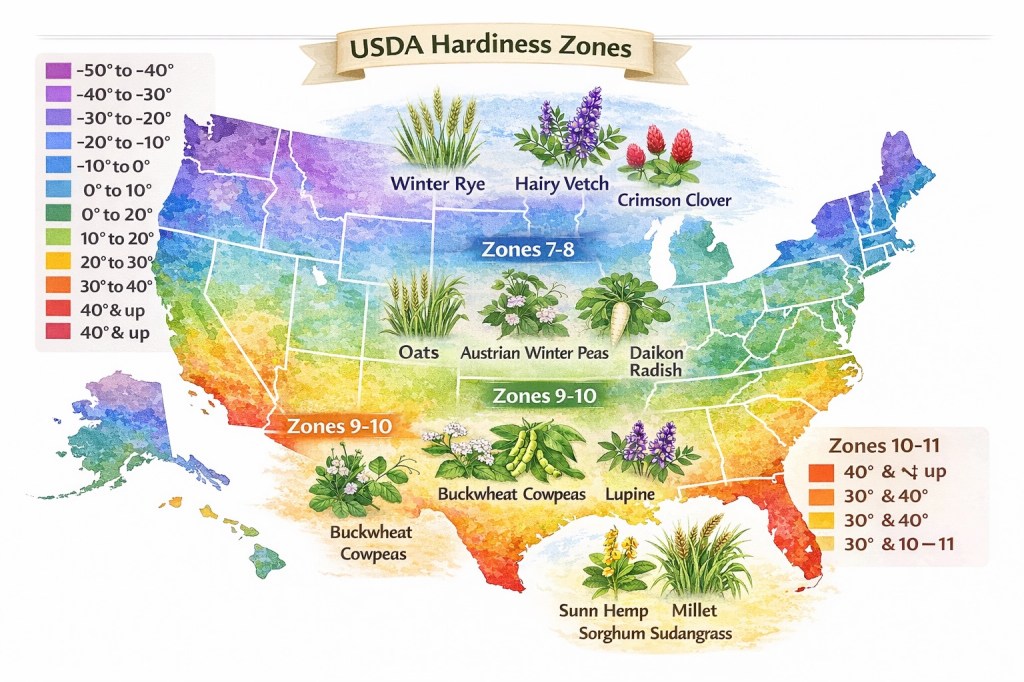
What Works Well in Raised Beds
Raised beds usually do best with simple, intentional mixes rather than large agricultural blends.
Legumes are especially useful. They support soil biology and can contribute nitrogen for the next crop. Cowpea and lupine are good examples in regions where temperatures allow them to establish quickly.
Root driven plants like daikon radish play a different role. Their taproots open channels in the soil, improving drainage and root access for future crops. When they break down, they add organic matter deeper in the bed instead of just at the surface.
Grasses can be used, but they tend to be less forgiving in small spaces. Their dense root systems can be harder to manage and may temporarily tie up nitrogen if not handled carefully.
From December to January, I covered my raised beds with a mix of cowpea, daikon radish, and lupine. The goal was not maximum growth, but keeping living roots in the soil, improving structure, and avoiding bare beds. Other mixes can work just as well depending on climate and timing.
Doing Something vs Doing Nothing
Doing nothing means leaving beds bare. The upside is simplicity. There is no planting, no management, and no termination step. In short off seasons or dry climates, this can be a perfectly reasonable choice.
The downside is exposed soil. Bare raised beds dry out faster, lose nutrients more easily, and slowly lose structure. Over time, this often means relying more heavily on compost and fertilizer to maintain productivity.
Doing something, even a basic cover crop, keeps the soil system moving in the right direction. The benefits include better moisture retention, improved soil structure, and healthier microbial activity. The tradeoff is the extra step of planting and eventually managing or removing the cover crop.
There is also a middle ground. Mulching with plant residue, chopped cover crops, or organic material can offer some of the benefits without fully committing to cover cropping.
Bottom Line
Cover cropping raised beds is not about chasing perfection. It is about protecting and improving soil in a small, high intensity space. Climate, timing, and personal bandwidth all matter.
For me, keeping something growing during the off season has been worth the effort. Even short runs with simple mixes help maintain soil health and reduce how much work the beds need later. Whether you use a diverse blend, a single species, or just light mulch, the principle stays the same: soil does better when it is covered.
 Grow Code Systems
Leave a comment